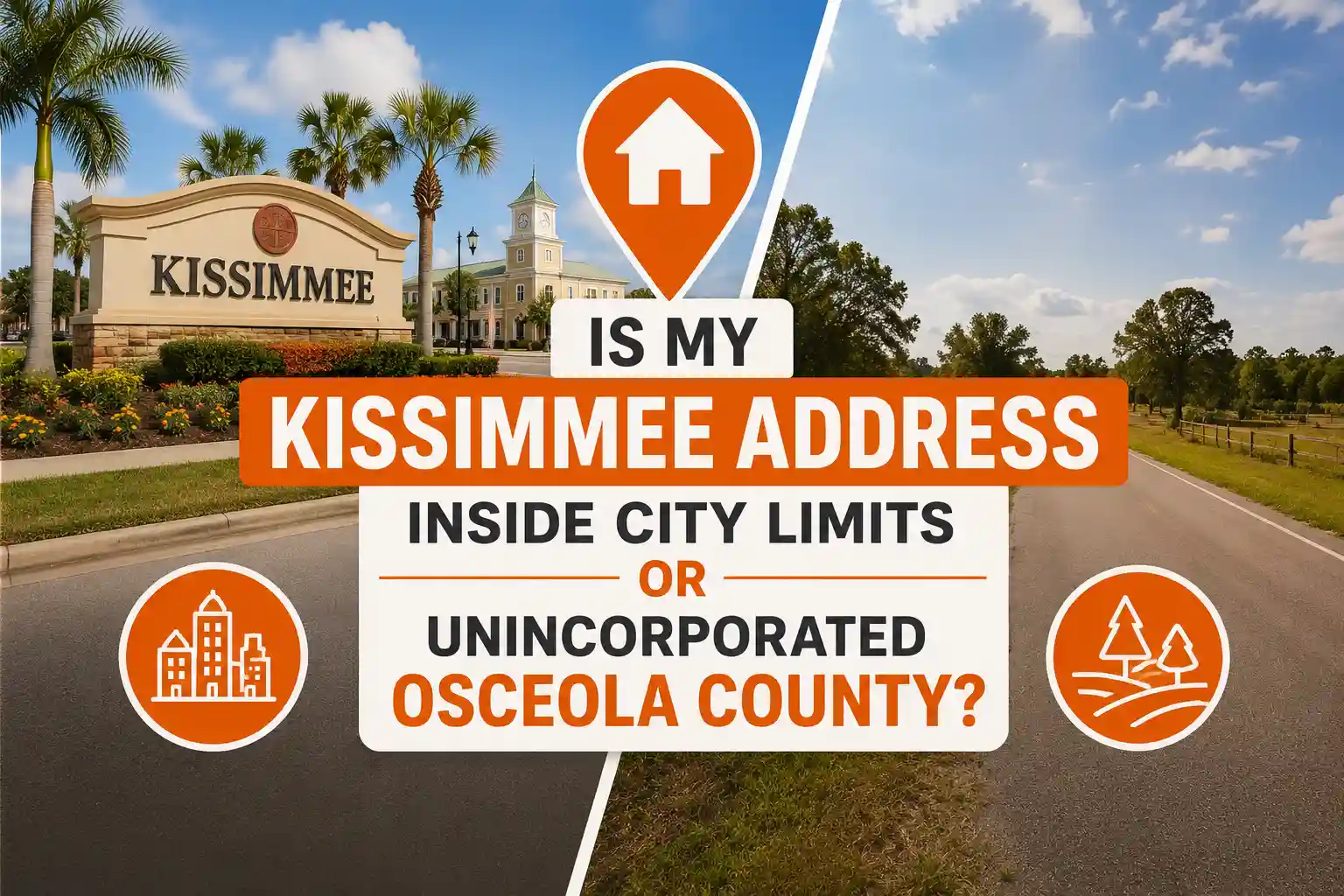
Is My Kissimmee Address Inside City Limits or Unincorporated Osceola County?
A Kissimmee mailing address does not automatically mean a property is inside the City of Kissimmee. Some properties with Kissimmee postal addresses sit in unincorporated Osceola County, where different offices handle building permits, planning, waste service, code enforcement, and public right of way questions. The distinction can also decide whether a particular commercial dumpster or roll off service is even available at that address. Confirm the parcel’s jurisdiction before relying on either government’s rules.
Quick Answer
Use the property’s parcel record and the City of Kissimmee’s official city limits map to determine whether an address is inside incorporated Kissimmee, in unincorporated Osceola County, or close enough to a boundary that it needs direct confirmation. Do not rely on the mailing city or the ZIP code alone. The City of Kissimmee itself warns applicants that an address can say Kissimmee while the property sits in unincorporated Osceola County.
A Local Example: Buenaventura Lakes
Buenaventura Lakes, known locally as BVL, is one of the clearest local examples of this gap between a mailing address and actual jurisdiction. BVL is an unincorporated Census designated place, not part of the incorporated City of Kissimmee, even though its properties commonly carry a Kissimmee postal address.
Osceola County lists BVL among its Special Assessment Communities, where the county’s Special Assessments Office oversees local services such as stormwater retention and drainage directly, rather than the City of Kissimmee.
That doesn’t mean the county controls everything in BVL. A state road may fall under the Florida Department of Transportation, a private community may have its own HOA rules, and a utility easement may belong to a separate provider. For a BVL property, Osceola County, not Kissimmee City Hall, is the right starting point for county permits, county planning, and county waste questions, but the specific road or easement in front of a given property may still answer to someone else.
Why the Mailing Address Does Not Set the Jurisdiction
Postal addressing and municipal boundaries are two separate systems. The postal service assigns a city name based on mail delivery routing, not based on where the City Commission has actually drawn the city limit through annexation. An address can read Kissimmee for mailing purposes while the parcel itself sits outside the incorporated city.
A Kissimmee ZIP code by itself does not establish the permitting authority, the planning and zoning authority, the waste service provider, the code enforcement office, which agency controls the nearby road, or commercial roll off eligibility. The parcel, and the exact location proposed for a dumpster, need to be checked separately from the mailing address.
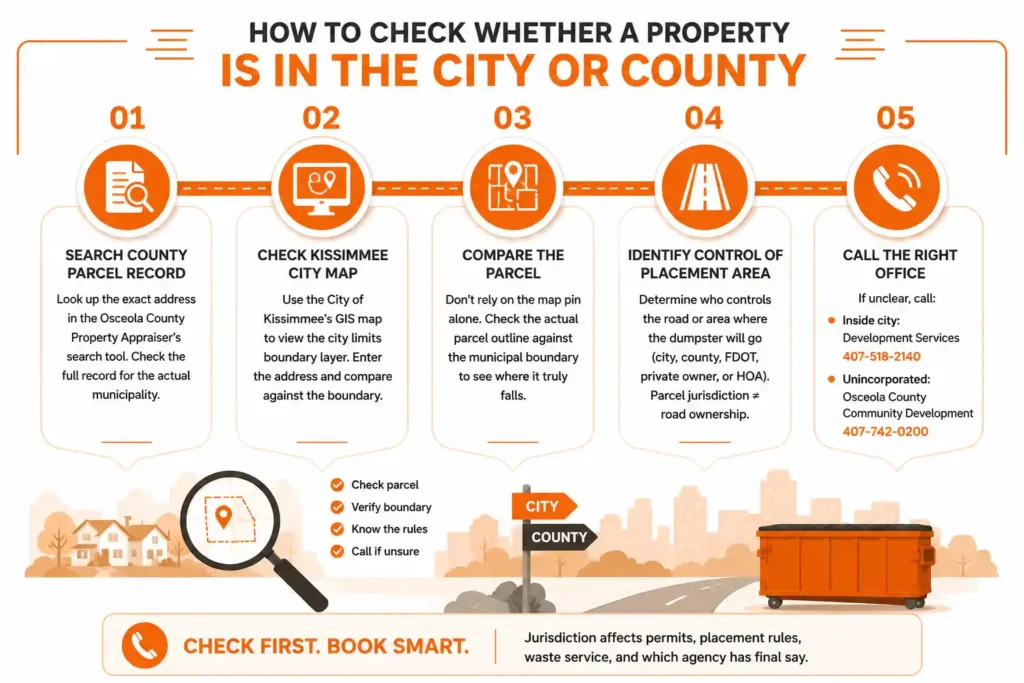
How to Check Whether a Property Is in the City or County
Step 1: Search the county parcel record. Look up the exact address through the Osceola County Property Appraiser’s search tool. Property records commonly include the parcel’s actual municipality, separate from any mailing address field, though the exact fields shown can vary, so review the full record rather than the address line alone.
Step 2: Check the City of Kissimmee’s map. The city’s GIS mapping tool includes a city limits boundary layer. Enter the address and compare it against the boundary line. The city describes this tool as a visual reference rather than a survey product, so treat it as a strong first check rather than a final legal answer.
Step 3: Compare the parcel, not just an address marker. A map pin can land close to a boundary without reflecting the actual parcel line. Look at the parcel outline itself against the municipal boundary.
Step 4: Identify who controls the proposed placement area. Even when the parcel itself is inside Kissimmee, the road beside it might be controlled by the city, the county, the Florida Department of Transportation, a private owner, or an HOA. Parcel jurisdiction and road ownership are related questions, not always the same answer.
Step 5: Call the responsible office if the result is unclear. For a property that looks like it’s inside the city, call Development Services at 407-518-2140. For one that looks unincorporated, call Osceola County’s Community Development Department at 407-742-0200.
What Changes Based on Jurisdiction?
| Question | Inside the City of Kissimmee | Unincorporated Osceola County |
|---|---|---|
| Building permits | City of Kissimmee Permitting Division | Osceola County Community Development, Building Division |
| Planning and zoning | City Development Services, Planning and Zoning division | Osceola County Planning and Design |
| Residential waste service | City of Kissimmee Solid Waste Division | County program with its contracted hauler |
| Larger commercial dumpsters, compactors, and roll-offs | Subject to the city’s exclusive commercial franchise | Provider eligibility confirmed under county rules |
| Bulk item collection | City process, for qualifying city accounts | County curbside bulk rules for eligible residents |
| Street or sidewalk placement | City or another controlling road agency | County, FDOT, or another controlling agency |
| Code enforcement | City Code Enforcement | Osceola County Code Enforcement |
| HOA or private property rules | Can apply in addition to city rules | Can apply in addition to county rules |
The most important thing this table can’t fully capture: parcel jurisdiction doesn’t answer every placement question on its own. The property owner, an HOA, fire access rules, and whichever agency controls the adjacent road can each have their own say.
The Commercial Roll Off Rule Inside Kissimmee
The City of Kissimmee offers Basic and Economy non-residential service for small commercial accounts generating under two cubic yards of waste a week. For anything larger, a dumpster, a compactor, or a roll off container, the city directs commercial customers to its exclusive franchised hauler, Waste Management, at 1-866-724-2989, rather than an independent provider.
Before assuming an independent company can deliver a large container inside city limits, confirm that the parcel is actually inside the city, whether the account qualifies for small city cart service instead, and whether the debris is residential, commercial, or contractor generated, since that classification can change which rule applies.
This specific city franchise does not govern a parcel in unincorporated Osceola County, including BVL, though county rules and provider eligibility still need separate confirmation there. Whether a contractor working at a single residential property inside city limits falls under this commercial rule or ordinary residential service is also worth confirming directly rather than assuming either way.
Building Permit Rules and Dumpster Placement Are Separate Questions
New permitting rules took effect statewide on July 1, 2026 under Florida House Bill 803. City guidance is direct about what changed: a permit is still always required for electrical, plumbing, mechanical, or gas work, any structural work, any project valued at $7,500 or more, or any work in a flood zone. The only categories that can qualify for an exemption are fencing, not including pool barriers, and roof repairs covering less than 25% of the total roof area, and only when the project is under $7,500 and outside a flood zone.
Even a project that qualifies still requires filing a written exemption request with the city’s Building & Permitting Division and getting the Building Official’s approval before work starts, then keeping the approved copy on site. Projects can’t be split into smaller pieces to get under the $7,500 threshold, and HOA rules still apply separately regardless of permit status.
None of this decides where a dumpster can sit. A roof repair that qualifies for the permit exemption can still need HOA approval, the property owner’s sign-off, or fire access clearance before a container is delivered, and having a permit for the work itself doesn’t automatically clear a container to block a street, sidewalk, or shared access route.
How Jurisdiction Affects Dumpster Placement
Private residential property. A container placed entirely on a driveway or private lot generally doesn’t use the public right of way, either inside the city or in the county. That’s not a blanket clearance. HOA rules, the property owner’s approval, easements, fire access, and any active construction permit conditions can still apply.
Public streets and sidewalks. Don’t assume placement is allowed on a street, sidewalk, or public parking space. Confirm the controlling agency first, since a Kissimmee mailing address doesn’t tell you whether that’s the city, the county, or FDOT on a state road.
Commercial properties. Get approval from the actual property owner, landlord, shopping center manager, or condominium association, and separately confirm whether the container falls under the city’s commercial franchise or county rules.
Construction sites. Check the approved site plan, permit conditions, fire lanes, staging areas, and how the debris is classified. A permitted job site can carry placement rules that don’t apply to an ordinary residential cleanout.
Who Should Customers Contact?
Inside Kissimmee city limits
Development Services, for planning, zoning, and general jurisdiction questions: 407-518-2140, City Hall, 101 Church Street Suite 200, Kissimmee, FL 34741
Permitting Division, for building permit applications specifically: 407-518-2379 or permitting@kissimmee.gov
Solid Waste Division, for residential trash or commercial container questions: 407-518-2507 or sanitation@kissimmee.gov
Waste Management, for commercial roll off, dumpster, and compactor service: 1-866-724-2989
In unincorporated Osceola County
Community Development Department, for building permits: 407-742-0200 or permitting@osceola.org, 1 Courthouse Square Suite 1400, Kissimmee, FL 34741
Planning and Design, for zoning questions: reachable through the county’s Community Development line above
Osceola County Solid Waste: 407-742-7750, 750 South Bass Road, Kissimmee, FL
General county assistance: 407-742-2275
Before Booking a Dumpster
Have this ready when you call: the property type, the project type, who’s doing the work, the debris type, the proposed container location, whether that spot is private or public, any HOA or property management contact, your preferred delivery date, and photos of the access area if you have them. That’s enough for jurisdiction and service requirements to be checked before an order is placed, though the final say on placement can still belong to the city, the county, the road’s owner, an HOA, or the franchised hauler, depending on the address.
Frequently Asked Questions
Does a Kissimmee ZIP code mean I am inside the city?
No. A Kissimmee postal address can sit in unincorporated Osceola County. Check the city’s limits map and the county parcel record before assuming city rules apply.
Is Buenaventura Lakes part of the City of Kissimmee?
No. BVL is an unincorporated Census designated place in Osceola County. County offices are the right starting point for county permits, planning, and waste questions there.
Who should I call when I’m not sure about jurisdiction?
Call Development Services at 407-518-2140 for a property that looks like it’s inside the city, or Osceola County’s Community Development Department at 407-742-0200 for one that looks unincorporated. Check the map and parcel record first if you can.
Can any dumpster company deliver a roll off inside Kissimmee city limits?
Not for larger commercial dumpsters, compactors, and roll offs. The city directs those customers to Waste Management under its exclusive franchise. Homeowner rentals and contractor-generated residential loads should be confirmed separately.
Can a dumpster be placed on a private driveway without a permit?
Generally yes for the right-of-way question specifically, but HOA rules, the owner’s approval, fire access, and any active construction permit conditions can still apply.
Can a dumpster be placed on a street?
Not without confirming who controls that road first, since it could be the city, the county, FDOT, or a private entity.
Did Florida eliminate building permits?
No. Under HB 803, effective July 1, 2026, only fencing and minor roof repairs under 25% of the roof area can qualify for an exemption, and only when the project is under $7,500 and outside a flood zone. Everything else, including any electrical, plumbing, structural, or gas work, still needs a permit, and even exempt work still requires a filed and approved exemption request first.
How This Information Was Verified
Jurisdiction and permitting guidance came from the City of Kissimmee’s Development Services and Permits and Inspections pages, including the city’s dedicated page on Florida House Bill 803 and the permitting changes effective July 1, 2026. Commercial collection and franchise details came from the city’s Commercial Collection Services page. BVL community information came from Osceola County’s Special Assessment Communities page. County permitting and planning contacts came from Osceola County’s Building and Permits page. County waste contact information was confirmed against independent business directories and a Florida Department of Environmental Protection county contact list. The description of what the Property Appraiser’s parcel record shows is based on secondary sources rather than a direct check of the official search tool, and should be confirmed against the live record for a specific parcel.
Government contacts, franchise arrangements, and permit procedures can change. Confirm current requirements for the exact parcel, project, and proposed placement before relying on this page.
Check the Address Before Booking
Call [ (407) 505-3963] with the complete service address, property type, debris type, and proposed placement. We can help identify the likely jurisdiction and what it means for your order, but the city, the county, the road’s owner, an HOA, or the franchised hauler may still have final say depending on the address.